
Project History
In 2022, Green Energy International (GEI) became aware of the National Grid’s plans to incorporate a new 400 kV substation into the existing overhead powerlines around Gretna. This new substation provides an opportunity to integrate much needed renewable energy such as solar, wind, and battery technology directly into the national grid without the need for miles of new overhead powerlines.
To assess the potential impact of the proposed solar energy park, a plan-level Habitats Regulations Assessment (HRA) was conducted. This assessment reviewed local impacts and effects on relevant nature conservation sites of European importance. Independent experts carried out the evaluation in consultation with statutory planning authorities, nature conservation bodies, and several non-governmental stakeholders. High-level landscape, heritage, archaeology, and transport surveys were also undertaken.
From 2022 to the summer of 2024, alongside these surveys, technical designs were developed, and legal agreements with landowners and farmers were established. Efforts were made to arrange the complex grid connection. By summer 2024, the project was introduced to the public for the first phase of community consultation.
Project Timeline
GEI submitted an EIA Scoping Report to the Scottish Energy Consents Unit in December 2025. This report presented the early project proposals and outlined how potential environmental impacts will be assessed.
- Summer 2024: Public Consultation Stage 1.
- Winter 2024 / 2025: Ongoing surveys, design changes, and preparation of the Environmental Impact Assessment (EIA) Scoping Report.
- December 2025: Submission of the EIA Scoping Report.
- January – March 2026: Public Consultation Stages 2, 3, and 4.
- 10 April 2026: Deadline for community comments. (The option to comment on the planning application will be made available via the relevant government bodies).
- 1 May 2026: Target submission date for the Section 36 application to the Energy Consents Unit.
- 2027 / 2028: Expected decision by the Energy Consents Unit.
The Developer
Wyseby Hill Energy Farm is being developed by Green Energy International (GEI). Since 2016, GEI has secured planning permission for numerous solar projects across England and Scotland. We are committed to delivering large-scale solar farms with co-located battery storage and achieving a minimum of 50% biodiversity net gain on every project.
Site Location
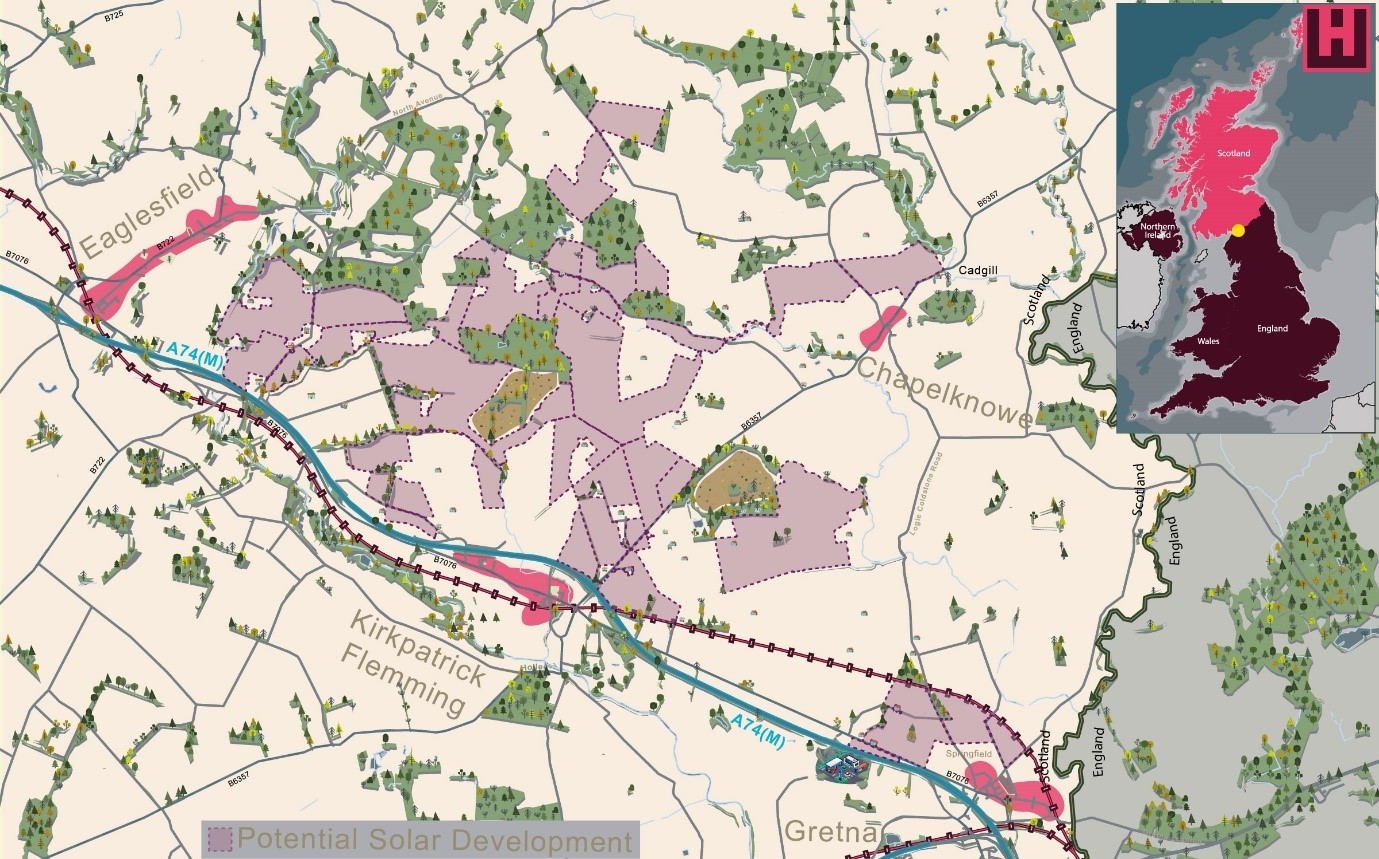
Wyseby Hill Energy Farm is located in Dumfries & Galloway, southern Scotland, about 14 kilometres southeast of Lockerbie. The site is positioned between the villages of Kirtlebridge, Kirkpatrick Fleming, Gretna Green, and Chapelknowe, sitting just 0.3 km north of the English border. It benefits from excellent access routes via the A74(M) motorway and the B7076, making it easily accessible while being surrounded by remote, sparsely populated farmland.
The project site covers a large area, but around 30% will be used for underground cables and ecological offset land, ensuring minimal disruption to the landscape. Centered on Wyseby Hill and Howgillside Farms, the development extends towards Gretna Green, Kirkpatrick Fleming, and Chapelknowe, framed by the A74(M) and B7076 to the west and south. The remaining boundaries are defined by nearby farms, rivers, and the West Coast Main Line Railway.
The UK Government is committed to reducing carbon emissions to net zero by 2050, and solar power is a key part of this strategy. By generating clean, renewable energy, we can reduce our reliance on fossil fuels and take meaningful action against climate change
As the UK moves towards a low-carbon economy, electricity demand is expected to double by 2050. Solar energy will play a crucial role in meeting this demand, ensuring we have a secure and sustainable energy supply for the future

The UK’s Sixth Carbon Budget sets an ambitious target of a 78% reduction in carbon emissions by 2035. Solar power is one of the most cost-effective and efficient ways to achieve these goals
The Climate Change Committee’s Progress Report in June 2021 highlighted the urgent need for increased renewable energy generation, with solar and wind power leading the way. Wyseby Hill Energy Farm aims to contribute to this by generating 750 megawatts of clean power. The exact layout and capacity will be determined following detailed site assessments and community consultation. As the project will exceed 50 MW, it will be classified as a Section 36 project under the Electricity Act 1989, meaning it will be reviewed and determined by the Energy Consent Unit.
Why Here?
Wyseby Hill Energy Farm is ideally located near major National Grid infrastructure, making it an excellent site for efficiently delivering clean electricity to homes and businesses. The area offers strong conditions for solar power generation, and the site’s proximity to a new National Grid substation ensures smooth integration into the wider electricity network.
Site Selection Process
Several factors influenced the decision to propose Wyseby Hill as the site for this energy farm:
Grid Connection Potential: Collaboration with National Grid identified priority areas that could meet rising demand while ensuring a stable electricity supply. The planned reinforcement and extension of the grid network in Dumfries & Galloway made this location ideal.”
Land Availability and Suitability: GEI conducted a thorough site search to find land that was both available and suitable for a large-scale solar farm. The area around Gretna Substation emerged as the best option due to its location, landownership, and connection potential.
Environmental Considerations: The project boundaries have been shaped by landownership agreements, environmental factors, and commercial viability. Boundaries have been refined to minimize environmental impact while ensuring practical solar energy production.
Community and Landowner Collaboration
The proposals for Wyseby Hill Energy Farm are being developed in close collaboration with local landowners and farmers who have long-standing ties to the area. These landowners are committed to sustainable land management, making them ideal partners for this project.
By working together, we aim to ensure that Wyseby Hill Energy Farm not only generates clean energy but also aligns with the community’s long-term goals, promoting both environmental and economic sustainability.
Supporting Local and National Goals
Ambitious climate targets have been set at both national and local levels, and Dumfries & Galloway is at the forefront of Scotland’s efforts to combat climate change. Wyseby Hill Energy Farm will play a key role in helping the region achieve these goals by generating renewable energy, reducing carbon emissions, and supporting local economic growth through job creation and infrastructure improvements.
High-Level Timeline
- 2022: Pre-application advice and surveys.
- 2022 – Summer 2024: Ongoing technical surveys, preliminary designs, grid connections, legal agreements, and preparatory work.
- Summer 2024: Public Consultation Stage 1 of 4.
- Winter 2024: Ongoing surveys, design changes, and preparation of the Environmental Impact Assessment (EIA) Scoping Report.
- Spring 2025: Submission of the EIA Scoping Report and Public Consultation Stage 2 of 4.
- Summer 2025: Preparation of the Environmental Impact Assessment and Public Consultation Stage 3 of 4.
- Winter 2025: Consultation Stage 4 of 4 and presentation of the final application.
- December 2025: Application to the Energy Consents Unit.
- 2026: Expected decision by the Energy Consents Unit.
The Developer
Wyseby Hill Energy Farm is being developed by Green Energy International (GEI). The approved Jockstown Solar Farm (2023) and the proposed Chapel Cross solar and battery farm are also GEI projects. These initiatives are part of a wider effort by leading businesses to develop the Chapel Cross Green Energy Hub, supporting long-standing enterprises that provide high-value employment and enhance the area’s environmental credentials.
GEI is at the heart of the UK’s renewable energy revolution, helping to realize our collective goal of net zero emissions through the deployment of solar energy. Since 2016, GEI has secured planning permission for numerous solar projects across England and Scotland. We are committed to delivering large-scale solar farms with co-located battery storage and achieving a minimum of 50% biodiversity net gain on every project.
Your Project Manager

I’m Matthew Bayley, the Lead Project Manager for Wyseby Hill Energy Farm. Please don’t hesitate to get in touch at any time by email, phone, or in writing. We value your input and are here to address any questions or concerns you may have.
Contact Information:
- Matthew Bayley, Lead Project Manager
- Telephone: 0161 696 7338
- Email: mat@greenenergy-int.com
- WhatsApp: 07887 509255
We look forward to working together with the community to make Wyseby Hill Energy Farm a project that benefits everyone.